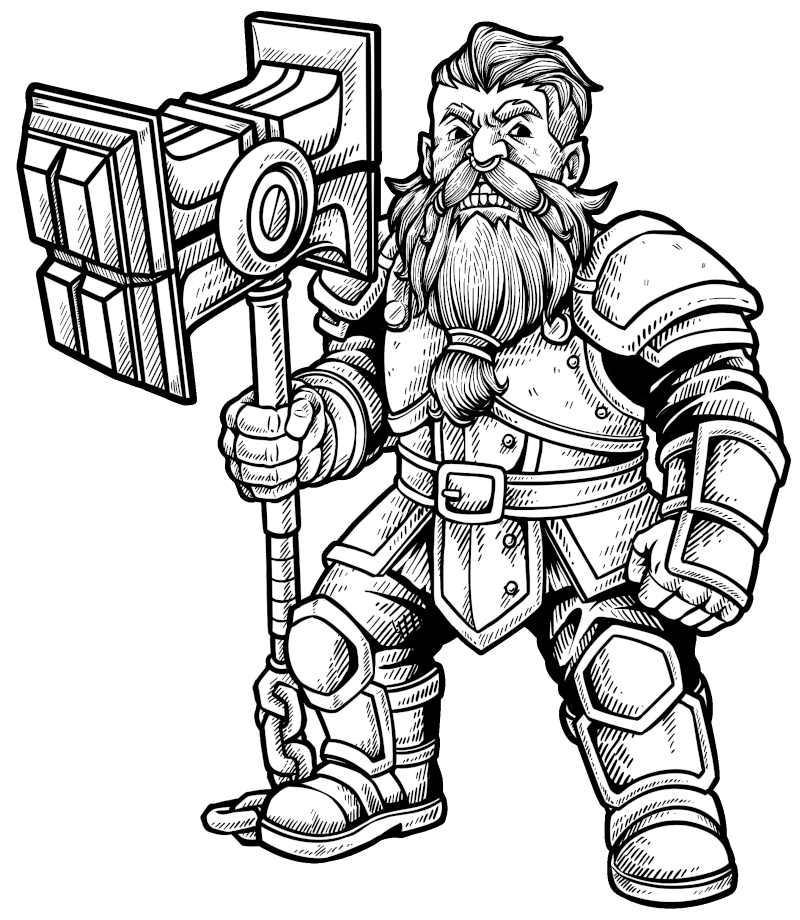
Argus Stonefury
Dwarven Warrior
A wild warrior bound by honor but driven by risk. Master of the warhammer, Argus walks the line between glory and gambling debts.
Introduction
In this article, we explore character generation in Abraxas. Abraxas interweaves character background and personality traits right into the character sheets. Abraxas focuses on character concept first, with a strong emphasis on a rich point-buy character-building experience.
Other games let you pick from a catalog of curated class and species combinations to define your character. In Abraxas, it is very often what do you want to do, not what can you do. Through this article, we will be following the Abraxas nine-step process. This process begins with the character concept and concludes with the GM review.
Step 0: The Invite
Let's watch Fred, whom Sally has invited to join her weekly fantasy game she runs in Abraxas. Sally tells Fred they are building on the "Heroic" Campaign Band, which means he has a set amount of dice and points to allocate.
There are several campaign bands in Abraxas, which serve as broad starting power levels for characters (Heroic, Superheroic, Cosmic, etc.). Heroic is closest to the action movie and pop sci-fi/fantasy style of realism. Dice are a measurement of both your natural raw potential (base Strength, raw Intellect, etc), Attributes, and what you know (Marketing, Marksmanship, etc), or Skills.
The critical part here is that Fred is being invited to a Fantasy game, which usually means magic and swordplay. Fred's job is now to create a character that fits into Sally's game, which ultimately begins with a concept that serves as a narrative sketch for the character.
Step I: The Concept
Fred likes the idea of a wild warrior who is honorable but a little reckless. Although his character has a code of honor that dictates his word is his bond, he also likes to push his luck, which sometimes gets him into trouble with the local bookies and militia.
This character will be a master of some type of weapon and make his living as an adventurer. This propensity for adventure and getting into trouble has led him to cross the paths of the local Orc Tribes, who have been less than impressed with his antics and have actively begun looking to put an end to his interference, permanently.
Step II: Primary Attributes
Building on the "Heroic" band means Fred has 18D (or 18 dice) to distribute amongst his Primary Attributes. Primary Attributes define the raw potential of your character and are rated between 1D and 5D, with 1D being not very good and 2D being average. 5D is truly incredible, and you may be world-renowned for your natural talent.
There are seven attributes in Abraxas:
- Strength - Physical strength
- Agility - Reflexes and coordination
- Stamina - Overall toughness and ability to exert yourself
- Intellect - Reasoning and logical thought
- Technology - Your proficiency with the tools and tech of your time
- Spirit - Mental strength, wisdom, and creative endeavors
- Charm - The ability to influence others with words
Fred wants his warrior to be a weapon master, which implies he has elevated physical Attributes. Fred ends up allocating his dice like this:
| STR | AGI | STA | INT | TEC | SPI | CHA |
|---|---|---|---|---|---|---|
| 3D | 3D | 4D | 2D | 2D | 2D | 2D |
He is exceptionally tough, boasting a 4D in Stamina and possessing above-average abilities in Strength and Agility. Pretty standard stuff for an athletic warrior-type character.
Step III: Skills
Skills are the things Fred's character has been taught or picked up over the years. On the Heroic band, the suggested amount of dice to allocate is 7D to skills. A warrior who specializes in a weapon will need some skills for that. Fred decides to allocate his skills as follows:
- Dodge (keeps Fred alive in combat) 1D
- Melee Combat (Fred is a skilled weapon master) 3D
- Throwing (Sometimes Fred needs to throw that weapon) 1D
- Fortitude (Athletic training; a must for a warrior) 1D
- Willpower (Stubborn as a...) 1D
We can already see how the concept we defined in Step I affects the organization of our Attributes and Skills. That narrative sketch we defined in Step I is a powerful tool that we use to describe everything Fred's character can do.
Optional Steps
The next set of steps is optional and highly dependent on the concept Fred selected in Step I. These four steps are all about defining Fred's warrior's in-game special abilities and perks. Fred uses a special currency called "Creation Points" (CP) to purchase options from the four categories. The exact amount of CP Fred has to spend comes from the "Heroic" band entry on the Campaign Band table. According to the table, Fred has 19 CP to spend on these mechanical and narrative options.
Step IV: Species
The first optional purchase Fred may make is something called a "Species Template". A species template is a collection of Advantages, Powers, and Disadvantages that define common physical traits for a species. A species template has a CP cost associated with it, depending on the species' in-game power.
Sally sends back a list of four playable species in her world: Human, Elf, Dwarf, and Gnome. A pretty classical selection; Fred decides to buy the Dwarf species template for 5 CP. This reduces his original CP pool from 19 to 14 but grants him in-game bonuses for being a Dwarf:
- Increased Strength - Dwarves in Sally's world are known for being physically strong
- Increased Stamina - Tough and durable as the stone
- Darkvision - Dwarves are a subterranean species and need to see in the dark
- Long-lived - Dwarves live approximately 400 years in Sally's game
- Poison Resistance - Dwarves are naturally resistant to toxins and venoms
Not everything is about a bonus, though. Being a Dwarf also imposes the mandatory acquisition of a Disadvantage:
- Short - Dwarves are physically powerful but usually around four feet tall, and are not made for the world of Humans and Elves. When travelling in those lands, it's common to be confronted with situations like how high the handle on the town well is.
Step V: Advantages
Advantages are in-game benefits that go beyond the plus or minus to rolls. These are things that have high narrative value, like knowing the courtier around the king or perhaps the King themselves. The Advantage assigns mechanical weight to a narrative element.
Fred's concept doesn't scream out for any Contacts or Favors; in fact, it sounds like Fred has people after him, not in a good way. He elects to skip this category.
Step VI: Powers
Powers in Abraxas are highly modular and customizable, and most importantly, generic. The same mechanical power can represent many different powers in Abraxas because we change the narrative wrapper with something called a Special Effect (SFX).
Fred decides to buy a Melee Attack power that only works when he drops an opponent in combat. He calls his power "Cleave," and it requires him to be holding a melee weapon when the target drops.
Melee Attack (+1D+2); Trigger +2, Downing an opponent; Limited Power -2, Requires a Melee Weapon; Requires A Skill Roll -3, Melee Combat, 10 TN
The name of the power "Cleave" is on the upper left. The numbers "5/7/2" are game terms, and the critical number is the last one (2)—that's the actual CP cost for this power. Cleave cost Fred 2 CP of his remaining 14, leaving him with 12 CP to spend.
Step VII: Martial Arts
Martial Arts in Abraxas are combat maneuvers that are sometimes standard combat maneuvers that have received an upgrade. Martial maneuvers are grouped to form a complete martial art style. Fred decides his character will use a Warhammer as his weapon of choice:
| Maneuver | Cost | Notes |
|---|---|---|
| Weapon Training: Warhammers | 1 | Enables martial arts skills while wielding a Warhammer |
| Striking Technique | 2 | Grants +1D damage when using martial art techniques |
| Swat | 2 | The "Jab" maneuver—solid attack with defense bonuses |
| Smash | 2 | The "Power Strike" maneuver—high damage, low accuracy |
| Knee Shot | 3 | Opposed Roll to knock target prone |
| Probe | 2 | Low damage, high defense attack |
Tallying up yields a total of 12 CP for this martial style. This is a costly point investment, but these maneuvers are crucial to Fred's combat options. With that, Fred has spent all of his remaining CP on Martial Arts.
Step VIII: Disadvantages
Now Fred gets to flex his narrative muscles. Disadvantages are tools that help you define your character's beliefs, flaws, quirks, and even enemies. The Heroic Campaign Band means he gets to purchase 15 points of Disadvantages:
- Physical Limitation: Short (0) – Required because of the Species Template. Zero points for this one.
- Hunted: Bloodrock Orcs (3) – This tribe of Orcs wants him to come to a loud, grotesque end.
- Hunted: Local Militia (2) – The local militia keeps an eye on Fred's character.
- Psychological Limitation: Risk Taker (3) – Common frequency, Strong intensity.
- Psychological Limitation: Devotion to Dwarven Gods (3) – Fred's character respects the old ways.
- Psychological Limitation: Honorable (3) – Fred's character keeps his word.
- Social Limitation: Gambling Debts (1) – Sometimes harassed by bookies and goons.
Step IX: GM Review
Fred sends Sally his character for review. Sally notes that Argus is a formidable frontline combatant with a scary amount of skill with that Warhammer. He is also complex with both a risk-taking personality and a code of honor. Coupled with his devotion to the Dwarven gods, you have a sophisticated belief system ready for play.
Sally double-checks the math and makes sure Argus falls within the Campaign Band power level, which he does, and approves the character for play.
Wrapping Up
Fred and Argus are clear to play in Sally's game!
What a journey. We went from the invite to a simple character concept for Argus. We then layered on mechanical and narrative options to give the narrative sketch form. Argus is more than just a collection of numbers at this point. We defined a complicated set of motivations and problems that follow Argus.
The character sheet Fred handed to Sally is a self-contained story generator that Sally can use to write her campaign, as well as provide story hooks for Fred. This is a key point—Fred has told Sally the types of adventures and narrative themes he wants to explore with Argus.
This is just a sample of what character generation looks like in Abraxas. What character would you build if you were invited to join Sally's game?
Ready to Create Your Own Character?
Start building your own legendary heroes in Abraxas Forge—no rulebook required.
Enter the Forge